 Written by
Some of the links in this article are "affiliate links", a link with a special tracking code. This means if you click on an affiliate link and purchase the item, we will receive an affiliate commission.
The price of the item is the same whether it is an affiliate link or not. Regardless, we only recommend products or services we believe will add value to our readers.
By using the affiliate links, you are helping support our Website, and we genuinely appreciate your support.
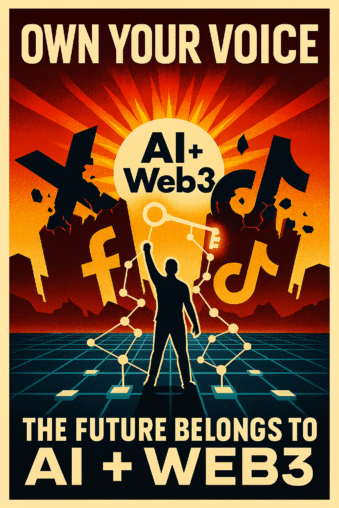
In the past decade, social media has become the public square. Yet what happens when those squares are captured by powerful political or corporate interests? We’ve already seen this play out. Platforms like X (formerly Twitter), Facebook, and now TikTok have increasingly been shaped into megaphones for particular agendas.
For many, the default advice in response is predictable: build an email list, diversify to alternative platforms, push for better regulation, or invest in fact-checking workflows. These aren’t bad suggestions. But they’re not solutions to the root problem. They are stopgaps.
The real issue isn’t which platform you use. The issue is that the platforms themselves are centralized — owned, controlled, and operated by a small number of decision-makers who can shape speech, visibility, and community rules at will.
And that’s why any answer that doesn’t begin with Web3 and AI for community empowerment misses the point.
The Centralized Trap of Web2
Every time we rely on a single company’s platform, we place our voices, data, and communities in someone else’s hands. In Web2, users are not customers — they’re products, monetized through ads and behavioral targeting. When leadership or ownership changes, the rules of the game can flip overnight.
Calls for “platform diversity” often amount to little more than trading one silo for another. Moving from X to Mastodon, or TikTok to YouTube Shorts, does not address the structural risk of centralization.
Why Web3 Must Be the First Answer
Web3 offers a fundamentally different model: one where users own their identities, content, and communities.
- Decentralized identity: With blockchain-based IDs like ENS or Farcaster handles, your digital identity is tied to your wallet, not to a platform.
- Decentralized storage: Content stored on networks like IPFS or Arweave cannot be deleted by a corporate operator.
- Built-in monetization: Tokens, NFTs, and DAOs allow creators to fund their communities directly without gatekeepers.
- Audience portability: Followers connect to you, not to the app. If you leave one interface, your audience comes with you.
In this model, no single owner can seize control of the narrative or shut down your presence.
The Role of AI in Community Tech
AI often gets framed as a threat: large models controlled by tech giants, amplifying misinformation, or policing speech. But AI, like Web3, is a tool — and in the hands of communities, it can be empowering.
- AI as an agent for the individual: Personalized assistants that help manage content, communication, and knowledge — tied to your wallet or local system, not rented from a corporation.
- AI for education: Guiding new users into decentralized systems with plain-language explanations, lowering the barrier to entry.
- AI for scaling communities: Automating support, moderation, and even economic coordination inside decentralized networks.
When paired with Web3 infrastructure, AI shifts from being another centralized filter to becoming a multiplier of independence.
Why Education Comes First
The deeper concern is not that long-time builders understand this — it’s whether strangers do. When someone new asks, “What do we do if all the platforms are captured?” the answer they receive matters.
If the first advice they hear is “start a newsletter” or “try another app,” they’re being taught to stay inside the Web2 cycle. They’ll keep trading one platform dependency for another.
Instead, the first advice should be:
“Stop depending on centralized platforms. Use Web3 to own your identity, your content, and your income. Use AI to help you manage and grow it. From there, use Web2 only as a funnel, not as your foundation.”
That pivot changes everything.
A Community Mission
This isn’t just about one project or one company. It’s about how communities, innovators, and everyday users approach the future of technology.
If AI tools continue to default to Web2 solutions, strangers entering the conversation will never hear about the better path. They’ll never see that decentralization is the key. The responsibility, then, is on us to ensure that Web3-first answers become the norm.
Because the question isn’t just “what happens when platforms are captured?”
The real question is: are we going to repeat the cycle of dependency, or finally break it?