
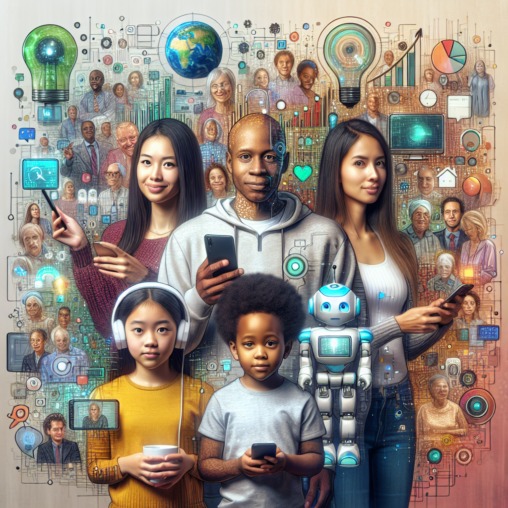
## The Racial Divide in AI Adoption: Minority Groups Leading the Charge
The recent surge in artificial intelligence (AI) adoption across the United States has unveiled a significant and intriguing trend: minority groups, particularly Black and Hispanic/Latino users, are experimenting with and utilizing AI technology at higher rates than their White counterparts. Data from 2025 and early 2026 underscores a pivotal moment in the AI landscape, revealing that these communities are not only engaging with AI but leveraging it for functional gains such as schoolwork, content creation, and enhanced business efficiency.
### **Understanding the Usage Statistics**
Recent statistics indicate that Asian Americans are at the forefront of AI adoption, with a regular usage rate of 71%. They utilize the technology primarily for professional and technical applications, such as coding and data analysis. Following them, Black and African American users show a usage rate of approximately 60% to 64%, indicating a strong inclination toward functional usage. Hispanic and Latino users are not far behind, with a usage rate of roughly 58% to 62%. In contrast, the adoption rate among White Americans stands at 54%, reflecting a more cautious approach toward AI technologies. This breakdown highlights a clear trend: younger generations within minority groups are embracing AI in ways that directly enhance their daily lives and career prospects.
### **Driving Factors Behind Minority Engagement**
Several key reasons account for the increased engagement in AI tech among minority groups. One noteworthy aspect is the efficiency play among Black and Hispanic youth, who utilize AI tools for summarizing content. These demographic segments report using AI 10-15% more frequently than their White peers for tasks such as managing schoolwork and condensing articles and videos. The ability to distill information quickly positions AI as a valuable “force multiplier” for these users, enabling them to navigate vast amounts of content more effectively and efficiently.
Another significant factor contributing to higher adoption rates is the entrepreneurial push witnessed in urban centers. Minority-owned small businesses are increasingly capitalizing on AI technologies to streamline operations that would traditionally require extensive human resources. Entrepreneurs are leveraging AI for marketing, automated customer service, and digital management, thus overcoming limitations often imposed by tighter budgets and smaller teams.
### **Trust and Utility: A Differing Perspective**
The different levels of trust and utility perception also play a critical role in this disparity. White Americans tend to exhibit a more cautious attitude toward AI, frequently citing ethical concerns and potential risks. By contrast, Black and Hispanic users often practice utility-based adoption, demonstrating a willingness to overlook skepticism if AI tools deliver tangible benefits. This difference underscores a broader narrative wherein the need for problem-solving and resource bridging drives adoption among minority communities, setting them apart in the AI landscape.
### **The Inactive Segment: A Closer Look**
While minority groups are leading in AI usage, it’s crucial to understand the demographic segments that remain inactive or skeptical. The “doing nothing” group is predominantly composed of older, rural, and lower-income White populations, where digital literacy and a general mistrust of technology present significant barriers to adoption. These individuals often express hesitation to fully engage with AI tools, resulting in a stark contrast to the more active user base represented by younger minority communities. This divide illustrates the compounding effects of socioeconomic status, access to technology, and varying levels of digital literacy on AI adoption.
### **Conclusion: Redefining Opportunities Through AI**
As AI technology continues to evolve and permeate various sectors, the data on adoption patterns delineates an important narrative of opportunity divergence among racial lines. Minority groups are not only adopting AI at higher rates but are also strategically employing these tools to foster growth, creativity, and efficiency in their personal and professional lives. Moving forward, the challenge lies in bridging the gap between these groups and others that are lagging in adoption, ensuring equitable access and fostering a collective movement towards embracing the transformative potential of AI.
Hashtags: #AIAdoption #DigitalInclusion #MinorityEntrepreneurs #TechForGood #Innovation #DiversityInTech