
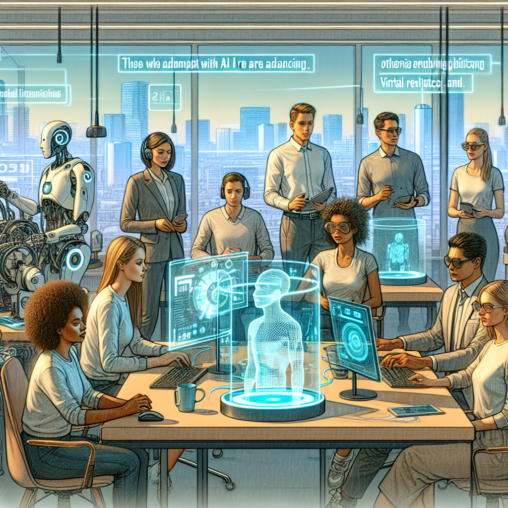
## It’s 2026: Either Get on Board with AI or Get Left Behind
### **A Tectonic Shift in the Global Economy**
In May 2026, the world silently transitioned into a new economic paradigm defined by artificial intelligence. The era of viewing AI as a simple “productivity hack” or a futuristic gadget has ended; it has firmly established itself as the backbone of professional existence. To navigate today’s workforce without a deep, integrated mastery of Agentic Workflows is to risk the relevance of one’s career. Attempting to operate as if it were still 2022—using outdated methods—resembles running a Fortune 500 company with only a rotary phone and a ledger. As AI becomes the standard operating system for business, professionals must embrace its capabilities or inevitably find themselves obsolete.
### **Understanding the Velocity Gap**
The divide between “AI-native” professionals and “manual holdouts” has grown startlingly wide; it is no longer a matter of percentages but rather of orders of magnitude. Manual holdouts, who still cling to traditional work methods, spend forty hours a week on research, drafting, and scheduling, producing linear outputs constrained by time. In stark contrast, AI-natives harness specialized agents to execute tasks in parallel, focusing on high-level strategy while their digital assistants handle the operational details. The exponential output generated by AI-native professionals places them in an entirely different league, where the market increasingly rewards speed and quality over the mere exertion of effort. Those who take weeks to deliver what an AI can produce in an afternoon will find themselves in an increasingly precarious position.
### **The Decline of Task-Based Employment**
One of the most significant transformations in 2026 is the devaluation of the “executor” role, a fixture in the workforce for decades. Careers that were once built around specific task execution—such as writing reports, coding basic programs, or managing logistics—are quickly becoming obsolete. Execution itself has transformed into a commodity, rendered irrelevant by AI-driven systems that perform these functions with extraordinary efficiency. The new professional hierarchy is emerging, one that prizes strategists and architects who can steer AI towards solving complex challenges while valuing the human verifiers who ensure ethical practices and maintain that essential “gut feeling” that AI still struggles to replicate. There is little room left for those who wish to return to the comfort of the past.
### **Embracing Adaptation for Job Security**
Resistance to AI often masquerades as a desire for “authenticity” or “human-centricity,” but beneath this cloak lies a fear of the learning curve. The hard truth that the workforce must confront is that AI doesn’t take jobs; it’s people who utilize AI that seize opportunities and outpace their peers. As the barrier to entry into new industries evaporates, the floor for acceptable performance has been raised to unprecedented heights. The tools at our disposal have evolved from simple chatbots to integrated systems that anticipate needs, automate workflows, and synthesize global data instantaneously. Ignoring this paradigm shift is not merely a personal choice; it constitutes a strategic exit from the professional landscape.
### **The Bottom Line: A Call to Action**
The transition from software-assisted work to AI-governed workflows represents one of the most aggressive pivots in human history. There is no longer a middle ground; the world’s infrastructure has been rebuilt around scalable intelligence. Professionals must recognize that they can either architect this scale, utilizing AI to amplify their capabilities, or risk being overshadowed by those who do. The train of progress left the station eighteen months ago; it is now time to stop gazing at the tracks and focus on climbing into the engine room. To thrive in this new reality, adaptation isn’t just an option—it’s a necessity.
Hashtags: #ArtificialIntelligence #FutureOfWork #DigitalTransformation #AIIntegration #WorkplaceInnovation #JobSecurity #Adaptation #CareerDevelopment